Causes Of Fading
Fading of interior furnishings is often attributed to ultraviolet radiation (UV) from the sun passing through windows onto interior surfaces. However, UV is not the only portion of the solar spectrum which can damage artwork or furnishings inside buildings. Virtually the whole spectrum is of concern, which is why long term exposure to solar radiation should be limited. Here we explain some of the contributions to fading and other damage of interior furnishings and materials due to solar exposure.
Supported by the outstanding energy-efficiency levels of today’s low-emissivity glasses, current architectural designs favour a large number of windows with clearer glass than ever before. Consumers also drive this trend, with their demand for large, open interior spaces flooded with natural light.
While this trend has brought more light into buildings, and in many case energy savings due to reduced electric lighting usage, another trend has, at the same time, made interior fabrics and finishes more fragile: the emergence of environmentally friendly materials.
Driven by pollution laws, fabric dyes, wood stains, paints and other coatings found in modern buildings have been formulated to have a more benign environmental impact, but may in consequence be less stable than their predecessor materials, typically, solvent-based. Today’s water-based products have a number of obvious environmental benefits, but some are more susceptible to fading over time, a significant drawback.
In addition, because of ozone depletion, higher levels of solar UV now reach the surface of the earth. This further contributes to the rate of fading. These three trends—more natural light transmittance, more fragile interior components, and a higher concentration of UV—have resulted in a greater awareness of fading.
What is Fading?
Fading is a change in colour with time. It is measured by evaluating the colour of a material at two or more points in time. Often it is a loss of colour or a reduction in colour saturation due to bleaching. For the purposes of this discussion, we are also interested in additional material damage due to solar exposure, such as embrittlement and cracking.
Causes of Fading
Fading has two main causes. The first is chemical, where chemical changes in the colouring agents of a material can cause a change (or reduction) in colour. Chemical reactions that lead to fading can be influenced by many environmental factors, such as the type of colouring agent/chemical, the chemical environment of each colouring agent in the material, the ambient chemical environment of the material, and the temperature, humidity, and radiation environment. In addition, wear or abrasion can physically remove colouring agents from a material’s surface.
Ultraviolet Radiation
The sun’s energy is made up of three distinct spectral components: ultraviolet radiation, visible radiation, and near-infrared radiation. What distinguishes these from one another is the wavelength ranges that characterize them, commonly measured in nanometres (nm). A nanometre is very small. A human hair is over 100,000 nanometres thick.
Ultraviolet radiation is invisible to the human eye and has the shortest wavelengths of the three types mentioned, from 300 to about 380 nm. Visible light covers the approximate range from 380 to 780 nm, while the near infrared radiation (sometimes called invisible solar heat) has the longest wavelengths, from 780 to 4045 nm.
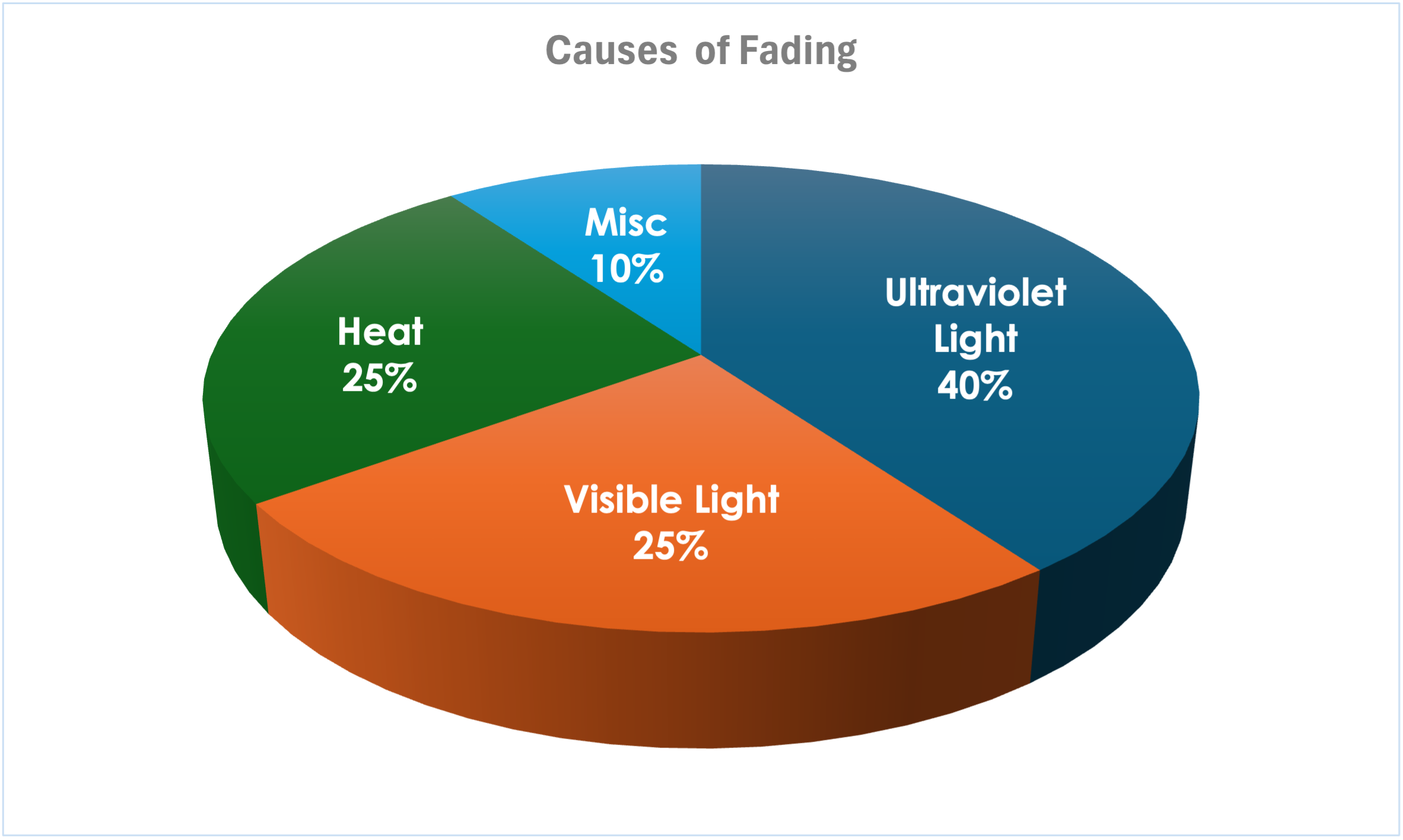
Ultraviolet radiation (UV) is the single largest contributing factor in fading of fabrics, carpets and other furnishings. Although visible light, electric lighting, heating, humidity, age of fabrics and fabric dyes all play a part in the process, UV radiation is attributed to 40% of the damage. Protecting against UV is not just important in hot, sunny climates. Even in cold, cloudy climates, UV radiation can damage furnishings.
© 2007-2014 University of Central Florida. The Florida Solar Energy Center (FSEC) is a research institute of the University of Central Florida.